Lepe’s back this week to start a series of posts on the fundamentals of whiskey. We hope you enjoy! – EZ

Whiskey Fundamentals Part I of IV.

So… you want to learn about Whisky, eh? Good, me too. In a previous post (A Very Personal Spirit) I talked about how each whisky is unique, its character brought about through simple ingredients (grain, water, yeast), time, and the distillers unique craft. However, I’d like to start with a basic primer on whisky; its basic ingredients, how it’s distilled, aged, and matured.

For this post, I’ll use Scotch as a point of reference. Scotch refers to whisky distilled in the traditional way in Scotland and aged for at least three years. I’ll get into the American distilling process in a follow-on post. The process is essentially the same as Scotch whisky, but the ingredients, distilling, and aging/maturing processes are a bit different.

A wee grain.hand of barley

All whisky is made from grain. This could be corn, rye, wheat, barley or just about any other grain. Scotch is made from barley, malted barley to be precise. Malted barley, or just malt, is barley that has been allowed to partially sprout (also referred to as germination and pictured below). I’ll get into that bit in a minute, but first; a few words about barley. Barley is a cereal grain in the grass family with many varieties whose grains have been harvested since humans began to farm. Barley is even mentioned throughout the New and Old Testament! Every grain is a little bundle of starches that are chemically converted into maltose sugar during the malting process. It is this sugar that distillers need for fermentation into alcohol, to eventually distill into whisky.

Why this grain and not another? According to Tom Standage, author of An Edible History of Humanity, and A History of the World in 6 Glasses, the domestication and use of barley grains by early farmers was as much about availability, and the amount of sugar that barley produces, as it was about selecting the properties that made the grain desirable; among them is the ability to germinate at the same time under similar circumstances. In this sense, barley is very easy to control. David Mair, Balvenie’s distillery ambassador, walked me through the process. (Click here for a quick video tour provided by David at thebalvenie.com) First, the barley is soaked in water for about two days in vats like the one below. In the following picture you can see a close-up of the barley being poured in!

Soaking the barley activates the grain as rain would in nature, the water is drained, the grain is then spread out on the malting room floor and left to sprout.

While the barley is on the malting room floor it is turned over every few hours to keep the shoots from getting tangled up and to manage the temperature of the now malting grains. At Balvenie they do this by hand and with the help of a machine like the one shown below to the right.

This process can take several days and is very dependent on keeping environmental conditions at just the right temperature and humidity to maximize growth. During the malting process the growing shoot starts to consume the grain’s starch. In order for a distillery to maximize the yield of sugar produced from the malt it has to halt the process at its peak by drying out the now malted barley. That’s where the kiln comes in. If you have ever been to a distillery you will have undoubtedly seen a curious structure like the one below. That’s the kiln and it is where some bit of craft happens.distillery

The barley taken from the malting room floor and spread out in the kiln to be dried by they heat of the fire in the lower part of the kiln. If peat is to be part of the mix to contribute its unique smoky flavors and aromas, it is here where it is introduced. However, the kiln’s fire must use a smokeless coal called anthracite. Using anthracite prevents unwanted odors from being absorbed by the damp malt. Below is a picture of the kiln’s fire (the malt, not pictured, is on a wooden surface far above).
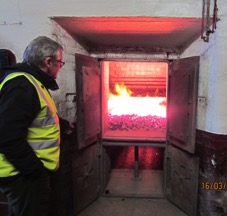
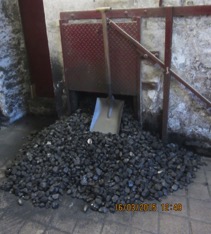
anthracite

peat
A pile of anthracite.

….and peat (below) is thrown into the fire in limited amount to help create Balvenie’s unique flavor.  After a couple of days, the malt is removed from the kiln and ready for the next step in its journey, which we will describe in part 2! -JLLS
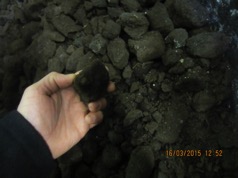
peat2
Lumps of peat. When burned peat produces a distinct aroma and flavor in the Whiskey. It also serves as a source of fuel for heating many homes.

Random notes. If you ever wanted to learn about barley production worldwide, but were afraid to ask look up the U.S. Department of Agriculture website:

http://www.fas.usda.gov/commodities

Also, for more on the science behind malting and distilling the blog below is very helpful:
http://whiskyscience.blogspot.de/2015/03/scottish-whisky-mash-bill.html

** Whisky Fact: If you ever wondered where “single malt whisky” comes from, its whisky made from malted barley from a single distillery.
 

Our good friend Lepe, who you’ll see from time to time here, is passionate to learn more about and share his whiskey. You can usually find him navigating his way through a great whiskey collection.  As Lepe says, we will discuss everything from the distillation process to how to “taste” whiskey.  Please enjoy as he introduces to the Thistle half of The Vine and Thistle, and stay tuned for Lepe’s next post exploring the fundamentals of the whiskey making process. Thanks Lepe… -EZ

Whiskey. The name alone conjures a gallery of images from dangerous outlaws at a saloon before high noon to posh gentry in their libraries. It’s a drink that is as much misunderstood as it is enjoyed the world over. But for however complicated a whiskey’s nose or impression may be, its recipe is remarkably simple.   For the most part, whiskey is made from three basic ingredients: water, some sort of grain (barley, wheat, rye, corn), and time in an oak barrel. What comes out however is a spirit so complex that two different people can taste the same dram yet their palates will paint a much different impression on the canvas of their mind.

To me, whiskey is indulgence and emotion. A swig of Old Overholt still takes me back to the dust and Old West kitsch of the Crystal Palace saloon in Tombstone, Arizona, where the bar promises good whiskeys and tolerable water.   A very generous 40 year-old cask strength dram from an exclusive Member’s Cask at Balvenie put me back in my grandfather’s musty, leather-bound library, as I slowly drank in his memory. A 12-year single malt Old Pulteney took me back to the Samuel Pepys pub in Huntingdon, Cambridgeshire, where I can still hear the raindrops lightly beating down against the window as I sit comfortably over a rarebit and sirloin burger in my favorite booth.

American poet and naturalist Diane Ackerman writes in A Natural History of Love, that love is like a beam of white light. When split by a prism the colors that are the emotions in the visible spectrum reveal themselves. Learning to appreciate a good whiskey is like splitting visible light. There is complexity, beauty and depth in what others overlook and take for granted.  The quest of finding your own personal whiskey will hopefully stir you to action and set forth unto the world to make new memories, relive old ones, and experience the goodness of life. Yes, it can be that good.

Beware though, like most trips of personal discovery, they can be wrought with some disappointment as is the fate, in my opinion, of a number of blended whiskies that scrape the mind with a rake. Johnnie Walker Black reminds me of every other hotel or airport bar in the Middle East and Africa. Chivas Regal mixed with Coca-Cola was the drink of choice of discerning high school students in Tijuana in the early ‘90s. The thought makes me cringe, and let’s face it, other than Margarita Carmen Cansino and the Caesar Salad, not much else of any enduring value has come from Tijuana. In case you were wondering, Margarita was “discovered” in the early 1930s at the Caliente Club by the head of Fox films and was later to be known as Rita Hayworth: dancer, screen legend, and pin-up icon of WWII…maybe I will give the Walkers and Chivas another shot; who knows what I’ll discover?

I truly enjoy learning, savoring and discovering whiskey, as I am sure you do as well, or at least want to. These posts are for those who live for the adventure of travel, history, good food, great whiskey, and esprit de corps!  So come by often, pour yourself a dram and stay awhile; you will always be welcome at our table.   -Lepe

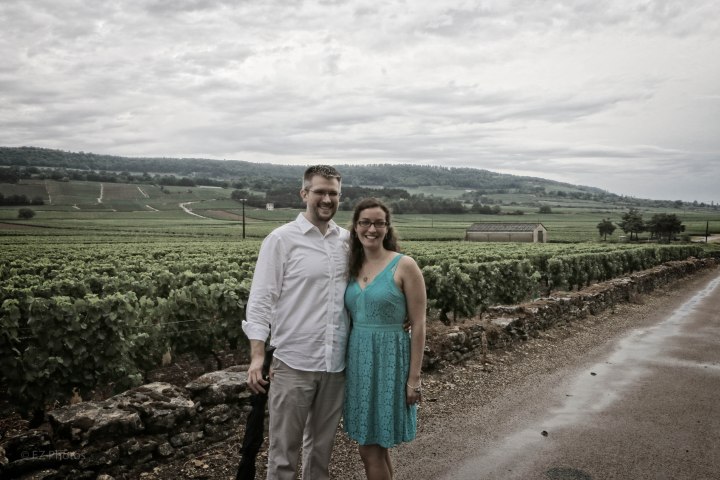
Welcome to The Vine and Thistle! My name is Ethan, and I must admit I’m a little nervous in writing this first post. As I sit here on the couch with my beautiful wife, Jackie, we embark on what we both consider the first step toward making a dream of ours a reality. That is, to share our love of wine and food with all who would sit at our table, albeit a virtual one for now.

With The Vine and Thistle, I want to open the world of wine to our guests, especially those just starting on their own journey. I want to learn from and educate others. We’ll discuss the language of wine, explore the wine regions of the world, share our favorite gadgets, as well as our favorite sites and sources for more information on all things wine. We want to answer your wine-related questions, whatever they may be.

With the help of our good friends we will also bring you into the world of whiskey, the “Thistle” element of The Vine and Thistle. Venturing into the world of these spirits and developing an appreciation for them are very recent things for us. The thought of pairing food with whiskey was crazy to me at one point. Only recently did I discover that this is not the case. We’ve found whiskey to be just as rewarding as our adventures in wine.

We love hosting wine tastings and multi-course wine pairing dinners in our home, and we try to demonstrate the magic that wine and food can make when paired together. In the process, sometimes we end up discovering with our guests how a certain wine doesn’t work. We also try to burst our guests’ preconceptions and challenge their palates. I’ve always enjoyed finding the white wine-only drinker and exposing them to a red paired with food, only to discover they love it; a proud moment indeed. We hope to inspire you to do the same. We’ll also share some tasting and menu tips on our site to help you share a special evening with your friends.

Having lived in Europe for the past five years, we have been fortunate to travel to many of the most celebrated wine regions in Europe; Bordeaux, Alsace, Bourgogne (Burgundy), Côtes du Rhône, Provence, Chianti, Alto Adige, Valpolicella, and Tuscany to name more than a few. My dream is to share these experiences with you, so that you too can discover how amazing wine can be. If you can only dream of venturing to Italy or France one day, or if you have been fortunate enough to visit for yourself, we want to take you back through wine and food.

Wherever this site may find you, we hope to make wine and whiskey more approachable, and you more a more confident wine fan. While we may not physically have room for you at our table right now, you’re always welcome at our site. Hopefully one day we will fulfill our dream and then be able to invite you to a physical table to share in our journey. So once again, thank you for stopping by, check in often, send us your questions and please feel free to let us know what you think. Enjoy!    -EZIMG_7248-Edit