
Lepe’s back this week to start a series of posts on the fundamentals of whiskey. We hope you enjoy! – EZ
Whiskey Fundamentals Part I of IV.
So… you want to learn about Whisky, eh? Good, me too. In a previous post (A Very Personal Spirit) I talked about how each whisky is unique, its character brought about through simple ingredients (grain, water, yeast), time, and the distillers unique craft. However, I’d like to start with a basic primer on whisky; its basic ingredients, how it’s distilled, aged, and matured.
For this post, I’ll use Scotch as a point of reference. Scotch refers to whisky distilled in the traditional way in Scotland and aged for at least three years. I’ll get into the American distilling process in a follow-on post. The process is essentially the same as Scotch whisky, but the ingredients, distilling, and aging/maturing processes are a bit different.
A wee grain.
All whisky is made from grain. This could be corn, rye, wheat, barley or just about any other grain. Scotch is made from barley, malted barley to be precise. Malted barley, or just malt, is barley that has been allowed to partially sprout (also referred to as germination and pictured below). I’ll get into that bit in a minute, but first; a few words about barley. Barley is a cereal grain in the grass family with many varieties whose grains have been harvested since humans began to farm. Barley is even mentioned throughout the New and Old Testament! Every grain is a little bundle of starches that are chemically converted into maltose sugar during the malting process. It is this sugar that distillers need for fermentation into alcohol, to eventually distill into whisky.
Why this grain and not another? According to Tom Standage, author of An Edible History of Humanity, and A History of the World in 6 Glasses, the domestication and use of barley grains by early farmers was as much about availability, and the amount of sugar that barley produces, as it was about selecting the properties that made the grain desirable; among them is the ability to germinate at the same time under similar circumstances. In this sense, barley is very easy to control. David Mair, Balvenie’s distillery ambassador, walked me through the process. (Click here for a quick video tour provided by David at thebalvenie.com) First, the barley is soaked in water for about two days in vats like the one below. In the following picture you can see a close-up of the barley being poured in!


Soaking the barley activates the grain as rain would in nature, the water is drained, the grain is then spread out on the malting room floor and left to sprout.
While the barley is on the malting room floor it is turned over every few hours to keep the shoots from getting tangled up and to manage the temperature of the now malting grains. At Balvenie they do this by hand and with the help of a machine like the one shown below to the right.


This process can take several days and is very dependent on keeping environmental conditions at just the right temperature and humidity to maximize growth. During the malting process the growing shoot starts to consume the grain’s starch. In order for a distillery to maximize the yield of sugar produced from the malt it has to halt the process at its peak by drying out the now malted barley. That’s where the kiln comes in. If you have ever been to a distillery you will have undoubtedly seen a curious structure like the one below. That’s the kiln and it is where some bit of craft happens.
The barley taken from the malting room floor and spread out in the kiln to be dried by they heat of the fire in the lower part of the kiln. If peat is to be part of the mix to contribute its unique smoky flavors and aromas, it is here where it is introduced. However, the kiln’s fire must use a smokeless coal called anthracite. Using anthracite prevents unwanted odors from being absorbed by the damp malt. Below is a picture of the kiln’s fire (the malt, not pictured, is on a wooden surface far above).
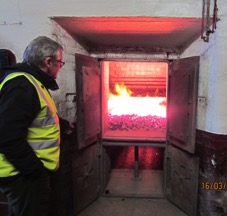
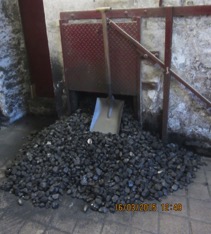
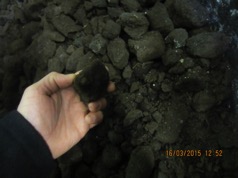
….and peat (below) is thrown into the fire in limited amount to help create Balvenie’s unique flavor. After a couple of days, the malt is removed from the kiln and ready for the next step in its journey, which we will describe in part 2! -JLLS
Random notes. If you ever wanted to learn about barley production worldwide, but were afraid to ask look up the U.S. Department of Agriculture website:
http://www.fas.usda.gov/commodities
Also, for more on the science behind malting and distilling the blog below is very helpful:
http://whiskyscience.blogspot.de/2015/03/scottish-whisky-mash-bill.html
** Whisky Fact: If you ever wondered where “single malt whisky” comes from, its whisky made from malted barley from a single distillery.
 The Vine and Thistle